Why Kiasu Parenting is a Waste of Time
- Imre Wessels

- Jun 20
- 5 min read
Updated: 4 hours ago
‘I’m afraid if my daughter doesn’t get an interest in reading, she will fall behind in school, won’t get good grades, won’t get into a good secondary school, won’t be able to go to university, won’t have a high-paying job, and won’t make enough pension contributions to retire comfortably!’, a nervous mum shared with her daughter’s teacher.
Her daughter is four years old.
The mom could be described as a kiasu parent. Kiasu is a Singlish term that is loosely translated as ‘afraid to lose’ or ‘fear of missing out’. Parents take a competitive approach to obtain the highest possible school results for their children. Improving their children’s grades is seen as a way to secure as many options as possible for their children in secondary and tertiary education.
The minor relevance of grades
Kiasu parenting is understandable considering the Singaporean context. Being a meritocracy, earning high grades used to increase the likelihood of future success. But changes in the way of work mean we should question whether that parental approach is still valid. Doing well on standardised tests is not a competence that anyone with a job is required to have. Employees are expected to solve real problems, be proactive, and collaborate with others. The consulting company McKinsey researched that skills such as creative thinking, taking initiative, and empathy will become more relevant. These skills are not mastered by pursuing high grades.
Getting high grades is not even the only path towards getting a university degree. Singaporean universities such as NUS, SMU, and NTU have Aptitude-Based Admissions, which means that factors other than grades are considered when admitting students. This gives an advantage to those with a genuine interest in a subject. These subject enthusiasts would want to know who is on the faculty, read professors’ books or research papers, and even correspond with them (academics rarely get fan mail). Aptitude-Based Admissions don’t replace grades, but give a better chance for those with a genuine interest, despite not having perfect grades. There are other admission pathways as well, such as first earning a Polytechnic degree.
All these changes are good news. It means more pathways are opening up. Parents who are worried about their four-year-old child’s university enrolment could consider worrying less, especially given that MOE actively supports a more holistic approach to development rather than focusing solely on standardised exam results.
The high grades route does little to make someone knowledgeable. Sure, children get exposed to a wide range of subjects. But they never asked for any of these subjects. Forcing someone to learn a subject is an incredibly ineffective way to transfer knowledge. Children learn for exams and forget about them afterwards. The hidden lesson is that learning is boring. It is something that is imposed upon you. And nobody wants to be coerced. That’s why there is no surer way to destroy someone’s interest in a subject than by making it part of the school curriculum.
Nurture vs. Nature
Economist Bryan Caplan shares sobering statistics in his book ‘Selfish Reasons to Have More Kids: Why Being a Great Parent is Less Work and More Fun Than You Think’. One of his conclusions is that nature has a greater impact than nurture does. In other words, Caplan argues that the genes parents pass on have a bigger impact on their child’s life outcome than their parenting. If nature has a bigger impact, then it means parents can spend a lot less on tuition, scolding children for not doing their homework, or stressing them out about their grades.
His evidence? Caplan compiled adoption studies from the US, Germany, and Sweden that track the income levels and educational attainment of adopted children. These adopted children resemble their biological parents (‘nature’) more than their adoptive parents (‘nurture’). The parenting that the adoptive parents provided did not override the impact of the child’s biological parents. This suggests that parenting matters less than most parents think.
An important caveat is that abusive and negligent parents do have a (negative) impact on their children’s life outcomes. But these adoption studies suggest that most of what parents do has no long-term effect on income levels or educational attainment. Where parents do have an impact is how their kids will remember them. And to a lesser extent, the political/religious beliefs of their children (though not the intensity of those beliefs). All the tuition classes, homework assistance, and scolding to do better at school produce short-term results but no long-term outcomes.
As the title of Caplan’s book states, being a great parent is less work and more fun than you think. Imagine spending less time scolding your child about school and more time pursuing activities that you both enjoy. Instead of assigning extra homework, build a stronger relationship. Surely, not being constantly stressed about your child’s education will also make you a better parent?
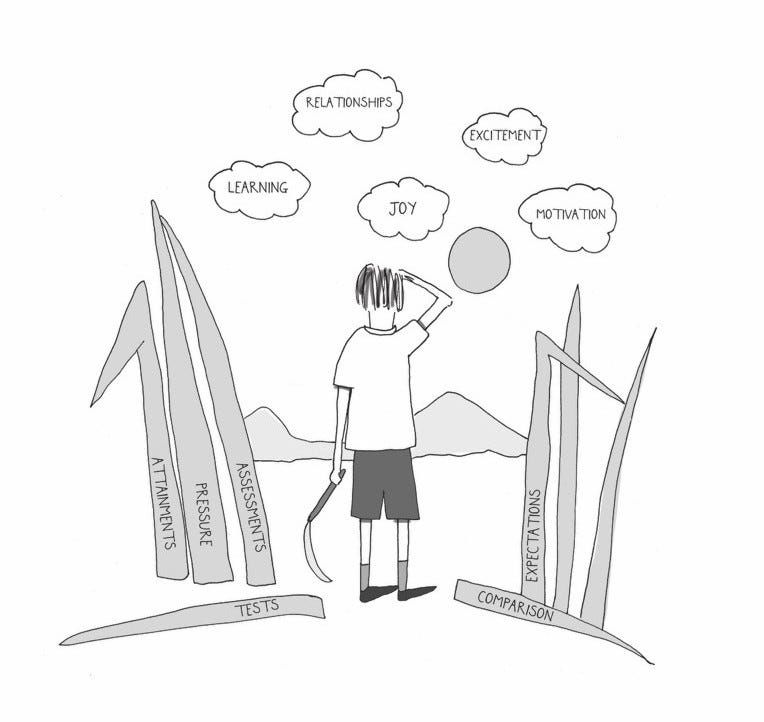
The opposite of kiasu
Caplan’s review of adoption studies examines income levels and educational attainment. He focuses on measurable outcomes. Advocates of Self-Directed Education focus on the hard-to-measure outcomes, such as intrinsic motivation, passion and creativity. Self-Directed Education is an educational approach that takes a holistic view of learning. Learning naturally arises from the learner’s self-selected activities and life experiences.
Parents who embrace Self-Directed Education don’t impose a curriculum, exams, tests or homework on their children. Instead, they allow their children to pursue their own interests. Parents act more as facilitators of their child’s interests. In the case of homeschooling, these parents would identify themselves as ‘unschoolers’. Parents who value this approach in a ‘school’ setting would choose a democratic school.
Children have a natural desire to learn and to become part of society. Very young children learn to walk and talk through sheer persistence, not through formal lessons. This natural curiosity is muted by traditional schooling. The wonder and questions about the world around them stop over time. That is because their interests do not fit into a curriculum.
Children in traditional schools learn to mute their own internal motivation and replace it with external motivation (praise, grades, and other forms of recognition). On the other hand, children who enjoy Self-Directed Education are free to pursue their own interests and discover their passions. They become knowledgeable about a great many things, although not all of what is learned fits neatly into a standardised school curriculum.
Research suggests that these self-directed children go on to have satisfying careers across a wide range of fields, especially as entrepreneurs, artists, or professionals in STEM (Science, Technology, Engineering, and Maths). They choose careers where intrinsic motivation, creativity, and self-direction are assets rather than liabilities.
Conclusion
More higher-education pathways are opening up for those motivated to pursue them, even without perfect grades. Research on adopted children suggests that parents might overrate the lasting impact of their parenting. And the experiences of those who pursue Self-Directed Education show that even doing the polar opposite of kiasu parenting opens up as many, if not more, pathways to satisfying and productive lives.


Comments